Home-Improvement:Interior-Design-and-Decorating Articles

Home-Improvement:Furniture Articles

Home-Improvement Articles

Showing posts with label tapestry historians. Show all posts

Saturday, April 25, 2009

Cumbrian Church’s History Sewn Up In New Tapestries

Cumbrian Church’s History Sewn Up In New Tapestries

Friends of a 400-year-old Cumbrian church have history all sewn up with tapestries to chart the building’s journey through the ages.

Longtown’s Arthuret Church – also known as St Michael and All Angels Church – is one of the oldest in the Diocese of Carlisle.

The tapestries are the latest in a year-long programme of 400th anniversary celebration events and were mounted on the church walls on Saturday when a special blessing was carried out.

Tapestry co-ordinator Christine Batey, of Oakshaw Hill, Longtown, said: “There are four tapestries now hanging on the wall of the church which have been made by about 40 friends of the church and other local people.

“About 40 people were involved and it has taken about 18 months to complete so it was quite a task to co-ordinate them all.”

Mrs Batey added: “I am really pleased with the way it has turned out, it has surpassed my expectations. The tapestries will hang in the church for years to come and I hope they will be admired by my grandchildren when they grow up.”

The Church of England church is led by The Rev Russell Tague and the Most Reverend Dr Idris Jones Primus.

It is now part of the benefice of three churches, St Michael and all Angels, Longtown; St Andrew, Kirkandrews-on-Esk; and St Nicholas, Nicholforest.

Between them they cover an area from the Scottish border to north of Carlisle.

The building, which dates back to 1609, has a long and important history which started with James VI of Scotland and the unruly Border Reivers.

The people of Longtown are marking the anniversary with a long programme of events, which started last November.

A flower show is planned for the summer. The theme will be the thistle and the rose to mark the ancient cross border connections of the church.

Taken From Cumberland-News.co.uk

Sunday, July 13, 2008

The Norman Fleet Event From the Bayeux Tapestry and More

The Norman Fleet Event From the Bayeux Tapestry and More

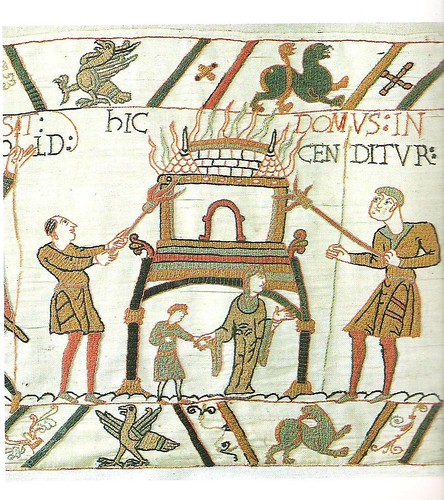
The Bayeux Tapestry was successful in providing a document that illustrates the events that transpired before and during the 1066 Battle of Hastings. As with many tapestries depicting an important event, there are several questions pertaining to its content.

For example, during the part where Harold Godwinson talked to William the Conqueror, there is a panel on the right side of the tapestry historians claimed pertains to a sexual scandal during that day. That scandal, up until now, is still unknown, and historians said it could probably be a scandal that the weavers thought needed no explanations.

It couldn't have been insignificant since it was included in the Bayeux Tapestry, it was probably a well-known scandal during the time. Parts of that panel were already altered in present day replicas, specifically the part that features two naked men with their genitalia exposed. Personal emphasis, critics said, could have also distorted the work's accuracy.

However, while its accuracy is disputed and the many mysteries surrounding it is still being debated, nothing ever like it has documented the event so accurately.

The part where William had initiated the war is the most elaborate in the Bayeux Tapestry. It did, after all, involved several figures and details. When William learned that Harold was crowned as king, he felt as if he deserved the throne. William had knighted Harold previously, before they defeated Brittany's Conan II and Harold returned from Normandy.

Since William thought Harold is a traitor and a usurper, he organized a fleet of ships to be used for his conquest. The tapestry illustrated the Norman's preparation; woodmen shaped trees into planks while men used the planks to build a number of boats. Weapons and food were then taken to the boats.

The panel after that showed William and his fleet of ships crowding the sea. Aboard Mora, the ship his wife Queen Matilda (the one who supposedly commissioned the creation of the Bayeux Tapestry, although documents later dispelled that rumor) bought for him, William lead his armada. The Norman reached England in September 28th. From Pevensey, they rode towards Hastings, where the battle took place.

From that point, the tapestry illustrated the Battle of Hastings, showing each side preparations. The tapestries illustration of the Battle of Hasting is brutal, showing the violence in detail. Several dead bodies were splattered on the tapestries lower border. Several panels were devoted in illustrating the battle, including the death of Harold's two brothers and, ultimately, the death of Harold Godwinson.

The Bayeux Tapestry at this point shows the preparation of kingdoms when they embark to battles. This also shows that war started at the slightest provocation. When one judges the wall hanging, it is not clear how the war started, except that William may have seen Harold's coronation as an attempt to usurp him. With the Bayeux Tapestry, the littlest details in the lives and culture of the Europeans during the Middle Ages are known to people who lived later.

Alex Hanson writes about how The Bayeux Tapestry is undeniably the most well-known and elaborate work of art in tapestries known in existence. Bayeux Tapestries woven from The Battle of Hastings in 1066 is what The Bayeux Tapestry is all about, shown in detail from the original which is 230 feet long and 20 inches high, which includes 77 events. It's a remarkable and beautiful work of art.

by Alex Hanson